
Recent Posts

The record for the fastest red card solved David Pratt, amateur soccer players in England. Striker club Chippenham got the red card during the match just running 3 minutes, because he is considered violation of the players hard to Bashley, Chris Knowles.
That happens in the match Primary Region South Division, last week. "I feel the referee decision is too heavy. But, he kubuat rate of diganjar deserve red card, then I accept it," said David Pratt.
The event was a big news in some British media on Monday (29/12). For, this is a world record. Previously, the red card is the fastest players Bologna, Giuseppe Lorenzo. In Serie-A League in 1990, he received a red card during the match run 10 seconds. Transgression, he beat Parma players.
"The record is not important for the world. This is not something that membanggakanku. I am not the type of player who hurt the opponent. Hasyrat I play with and commitment. At that time, I see the ball and try to tekel," said Pratt.
In addition, Bashley finally overcome Pratt 2-1 team. According to the Bashley manager, Steve Riley, the referee is right to give red card to Pratt.
"Pratt shows the action that directly manage my players. Aksinya potential to break the legs of people. Referees have no other choice except give a red card," said Riley.


The father of development is dead.
Venerated for much of his 32-year tenure as the liberator he appeared to be after more than two decades of authoritarian rule under his predecessor, Sukarno, and vilified near its end for his authoritarian rule and for the corruption he appeared to condone in his later years in office, Indonesia's second president, Soeharto died quietly Sunday aged 86 at Pertamina Hospital.
A complication of illnesses had sapped the former military strongman of his vitality during the last years of his life. He leaves behind the partially grown seeds of an ambitious industrial modernization plan and a legacy of sectarian strife and unbridled corruption.
Soeharto's rise to the peak of executive power began in 1968, in the wake of the abortive communist coup three years earlier. The ascension of the unassuming, quietly smiling general, the polar opposite of the charismatic and hugely popular foundingpresident Sukarno, took many of his countrymen by surprise, many of whom believed Sukarno had a unassailable hold over the nation.
And yet, given the country's political makeup and power constellation of the day, Soeharto quickly established he was more than enough equipped for the post he was to assume, despite humble beginnings and earlier frustrations.
Some confusion regarding his origins aside, the official accounts record that Soeharto was born on June 8, 1921, to a poor but not unimportant farmer's family in Kemusuk, about 15 kilometers northwest of Yogyakarta. His father, Kertosudiro, was a village irrigation official in charge of overseeing the allocation of water to irrigate the different fields in the village. His mother, Sukirah, was a village woman from a neighboring hamlet.
The marriage broke down just a few weeks after Soeharto's birth and the child was entrusted to the care of his paternal great aunt, from where he returned to live with his mother only after she remarried. And although schooling began when he was only four years old -- a most unusually early age, especially forIndonesian village children of that time -- his formal education was disrupted several times because the young child's frequent shuttling between relatives in his extended family.
From this troubled, itinerant youth, Soeharto was later to remember with special fondness and gratitude the time he spent with the family of one of his paternal aunts, the wife of a senior agricultural official, Mas Ngabei Prawirohardjo. It was here at Wuryantoro that Soeharto appeared to have spent his most formative period. It was here too, through his relationship with the Prawirohardjos, that he was to meet his future wife, Siti Hartinah, the daughter of the district chief of nearby Wonogiri, RM Soemoharjomo.
After completing his secondary schooling in 1939 at the age of 17, Soeharto left a troubled childhood behind and started work as a clerical assistant at a local bank in Wuryantoro. The job didn't last long. Soon after he started work, his banking career was terminated after he tore a piece of his clothing, which he said he could not afford to replace.
Desperate for work but not very successful in finding a suitable job, Soeharto enlisted with KNIL (Royal Netherlands Indies Army), where he began service on June 1, 1940, and it was there that he received his basic military training. But although he reportedly did well and was later accepted to the KNIL officer training school in Gombong, Central Java, in December of that year, his real opportunity for a solid military career came in March 1942, with the Japanese occupation of the Dutch East Indies and the subsequent proclamation of Indonesia's independence on Aug. 17, 1945.
After the establishment of the BKR (the People's Security Body) and subsequent TKR (People's Security Army) -- both forerunners of the Indonesian National Army, or TNI -- in which he took an active role, Soeharto's military star steadily rose.
Promoted to the rank of lieutenant colonel in 1945, he distinguished himself during the Dutch military occupation of Yogyakarta, the new Republic of Indonesia's war capital. Despite some controversy over the exact role he played in the renowned March 1, 1949, daytime assault on Dutch strongholds in Yogyakarta, his leadership as commander in the field at the timeremains undisputed and the attack served its purpose ofconvincing the world that the Indonesian Republic continued to exist and had not succumbed to the superior Dutch military might.
The same tactical and strategic mastery that Soeharto had displayed during the war for independence served him well during and after the traumatic days of October 1965, following the alleged communist coup in September. And those who have ever wondered how Soeharto had managed to wrest the seemingly absolutepowers from the hands of his predecessor, Sukarno, and go on to become a near-absolute ruler himself, will have to admit that Soeharto's tactical and strategic mastery in politics was virtually unrivaled for his time.
With patience, skill and resolve -- and a philosophical world view that he conceivably acquired from his troubled childhood and his typically Javanese upbringing -- Soeharto always remained true to the Javanese saying alon-alon waton kelakon (slowly but surely) and never made a move, in war or in politics, until he was certain that the victory would be his. Given the right moment, however, he could strike swiftly and with the ruthlessness of a Javanese potentate of old. With that skill and patience, he moved to gradually unseat Sukarno from the presidency, defying protests that he was moving too slowly.
On March 11, 1966, while still only a commander of the Army Strategic Reserves Command (Kostrad) leading the fight against the coup's plotters, he sent four of his generals to Bogor, Sukarno's sanctuary, to wrest from the president the authority to take whatever action he thought was necessary "to restore orderand protect the president." Mysteriously, the original document has since disappeared.
With that mandate in hand, however, Soeharto quickly moved to outlaw the Indonesian Communist Party (PKI), dismiss and arrest 15 of Sukarno's cabinet ministers, and appoint a new cabinet with Soeharto himself as head of the presidium.
From that point on, history proceeded quickly.
Soeharto undid all of Sukarno's left-leaning policies. He stabilized the economy, restored good relations with Malaysia and foreign investments were welcomed. Appointed Acting President as a stand-in for the now socially and politically isolated Sukarno, Soeharto was named full president on March 27, 1968 by a People's Consultative Assembly whose members were, discreetly, handpicked by Soeharto.
Under Soeharto's New Order, old roads were repaired and new roads constructed, irrigation ditches were built, factories rose across the country and the banking industry seemed outwardly to flourish. A master in translating complicated issues into a language the common people could understand, he regularly captivated audiences of peasants in the villages. A picture ofrising wealth and growing prosperity was painted for the people to refute the increasing grumbles of hardship, earning him the designation of Indonesia's "father of development."
To govern effectively and to carry out his economic programs without disruptions, however, political stability was needed. Therefore, open dissent was suppressed. For the purpose of keeping political parties -- and the legislative bodies, the House of Representatives and the People's Consultative Assembly(MPR) -- in rein, a machinery, was created in the form of Golkar to make sure that Soeharto, the president, won the majority of votes in support of his policies every time.
Within the judiciary and throughout the entire bureaucracy, the same policy was pursued: to make sure that officials toe the government line while preserving an outward facade of democracy, all the state institutions were revamped and peopled with New Order supporters. But while in this way political stability was indeed ensured, at least for the time being, those policies provided a fertile breeding bed for corruption, which, indeed thrived and blossomed beyond imagination and, over those three decades under the New Order, quickly came to infest nearly all walks of life.
In the end, however, the 1997 Asian financial crisis burst to expose the ersatz glitter and, combined with the discontent that had been simmering domestically among the oppressed masses, proved too much for even Soeharto to handle. In May 1998, Indonesia's longest-ruling president was forced to resign amidriots and popular protests the extent and ferocity of which the nation had seen only a few times before.
The father of development is dead. But as for Indonesia, Soeharto's demise, and that of the New Order he founded, marks not only the end of the remarkable life and the loss of a great if controversial leader, but hopefully the end of an era of extended autocratic presidencies as well.
President Susilo Bambang Yudhoyono expressed the government's condolences after Soeharto died, asking the Indonesian people to pray for him.
Soeharto's body will be transferred from Pertamina Hospital to his home in Cendana, Menteng, Central Jakarta. The President is scheduled to visit the Soeharto home later this evening.
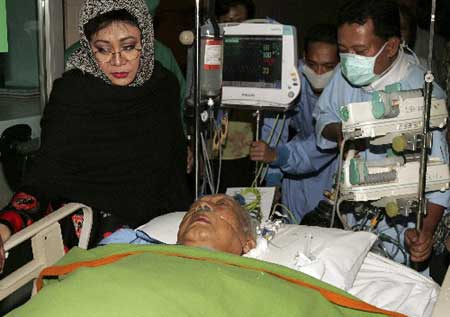 Former Indonesian dictator Suharto was on life support but showed slight signs of improvement, doctors said Saturday, a day after he suffered organ failure and was placed on a ventilator. When asked if he was in pain, the 86-year-old nodded, a doctor said.
Among the stream of visitors at the hospital in recent days was Indonesian Attorney General Hendarman Supanji, who said the government wanted to settle a civil corruption case against the former ruler — seeking $1.5 billion in damages and funds allegedly stolen from the state.
Lawyers representing the ailing ex-dictator, however, rejected the offer, and said it was not the time to discuss it.
"How we can accept this offer when there is no evidence of corruption?" Otto Cornelis Kaligis told The Associated Press.
A day earlier physicians had described Suharto's condition as "alarming," and family members and friends rushed to his bedside, some reciting prayers and verses from the Quran as he started to lose consciousness.
Health Minister Siti Fadilah Supari said she was pessimistic, and that doctors were making a "last attempt" to keep him alive. But chief presidential doctor Marjo Subiandono said there were signs of improvement overnight.
"His condition is better," he said. "He's more aware, responsive."
While Suharto remained on a ventilator, antibiotics appeared to be having an effect on his infected lungs, Subiandono said. Suharto would remain on life support to avoid damage to his vital organs, he said.
Another physician, Joko Raharjo, said the former strongman nodded when asked if he was pain. He was given a tranquilizer and drifted back to sleep.
Suharto, whose regime was widely regarded as one of the 20th century's most brutal and corrupt, was hospitalized in critical condition a week ago with anemia and a low heart rate. He initially responded well to a blood transfusion and kidney dialysis, but days later his condition sharply deteriorated.
The retired five-star general was ousted in 1998 amid massive student protests and nationwide riots, opening the way for democracy in this predominantly Muslim nation of 235 million people. He withdrew from public life, venturing from his comfortable villa on a leafy lane in the capital, Jakarta, only to attend family functions or for medical emergencies.
A series of strokes in recent years have left Suharto with permanent brain damage and impaired speech — keeping him from facing trial. He has been accused of overseeing a purge of more than a half-million leftist opponents soon after seizing power in a 1965 coup. Hundreds of thousands more were killed or imprisoned in the decades that followed — crimes for which no one has ever been punished.
Transparency International says Suharto and his family also amassed billions of dollars in state funds — an allegation he has denied.
Aids said privately that Suharto appeared to be on the verge of death late Friday, and Health Minister Supari said he should be allowed to die in peace.
Family members, however, decided to have him placed on the ventilator.
-
Recent Comments
-
Feature Posts
